
Postdoc focusing on autonomous systems and manned–unmanned teams in land combat
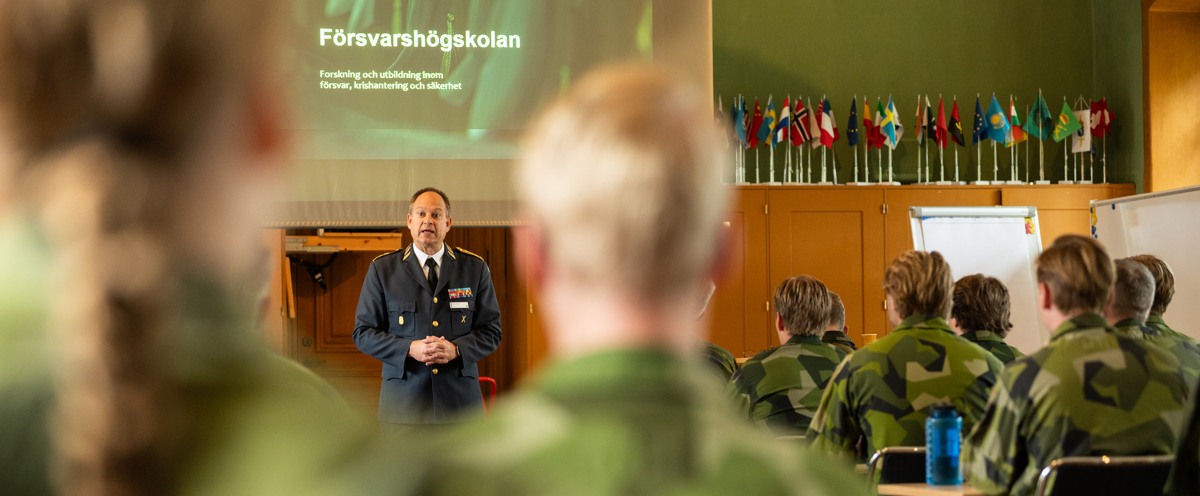
The Swedish Defence University is an internationally renowned university in the area of defence, crisis management and security. We offer a unique academic environment where military and civilian researchers, teachers and students interact. We educate and train top-level executives, experts, and researchers for the task of analyzing and managing current and future crises, security issues and conflicts. The university educates all military officers in the Swedish armed forces and leads the academic progression of the military profession. We conduct research in the areas of Law with a focus on International and Operational Law, Leadership and Command & Control, Military History, Political Science, Systems Science for Defence and Security and War Studies.
The Department of Systems Science for Defence and Security conducts research and education at the intersection of social sciences and engineering. The subject is interdisciplinary and studies how a combination of social and technical components affect the systems used for the defence and security of society. The subject's employees primarily teach within the Officer Programme, the Master's Programme Innovation, Defence and Security, and the Higher Officer Programme. They also contribute by provided teaching and expertise in other civilian and military education programmes, including contract education commissioned by both governmental and private parties. Research is either financed by grants or commissioned by contract.
The Swedish Defence University hereby announces a postdoc position focusing on autonomous systems and manned–unmanned teams in land combat at the Department of Systems Science for Defence and Security in Stockholm. The postdoctoral researcher will primarily do research within SEDU’s Institute for Warfare at the Centre for Land Warfare contributing to a research project focusing on the growing importance of autonomous vehicles, UxV, in unit contexts and how these can be integrated into future land combat units. The project places particular emphasis on the interaction between manned and autonomous platforms (“manned–unmanned teaming”) in future units.
Of particular interest is developing a comprehensive understanding of how autonomous systems interact with manned units, command-and-control systems and other capabilities within an integrated combat system. The project may include Swedish and international case studies, doctrinal and tactical analysis, modelling and simulation, wargaming/experiments, or other methods suitable for illuminating the research questions. The aim is to generate knowledge that can support the design and development of future Swedish land combat units, with particular focus on the needs of the Swedish Armed Forces.
A central theme is the mix of manned combat vehicles, ground-based autonomous systems and airborne autonomous systems in the land domain, involving both lighter and heavier platforms and a range of weapon systems. The project examines how this mix affects organisation, tactics, command and control, sensors, weapon systems, logistics and vulnerability.
SEDU’s Centre for Land Warfare and the Institute for Warfare conduct research and development primarily for the needs of national defence. The institute’s contributions may focus on capability development, competence development as well as knowledge development, and on building systems for military flexibility. The institute is a meeting place and a platform for collaboration within the Swedish Defence University and with the Swedish Armed Forces, as well as with other partners in the defence sector both nationally and internationally. The SEDU Centre for Land Warfare has a particular responsibility for the land domain.
The position will be based at the Department of Systems Science for Defence and Security. Systems science for defence and security is a field at the intersection of the social sciences and engineering. Research and teaching within the field address systems that contribute to or affect society’s defence, involving both technical and social components. In systems science for defence and security, the point of departure is that technical and social components cannot be studied in isolation from each other. The focus is on the study of the development, acquisition and use of technology and materiel for defence and security.
The project is carried out in close cooperation with the Swedish Armed Forces and the Swedish Army, and the results are expected to contribute directly to their unit and concept development.
Duties
The main duty is to contribute to the research project by conducting independent research and research together with other project members. The work has a clear applied orientation where you, together with other project members, produce material, analyses and recommendations that are directly useful to the Swedish Armed Forces. Your duties include disseminating knowledge by publishing scientific articles and presenting research results, for example at international conferences. The position also includes teaching in relevant courses, seminars and workshops within the Swedish Armed Forces, especially the Swedish Army; participating in reporting seminars with the Swedish Armed Forces, including being prepared to support relevant studies, workshops and training within the Swedish Armed Forces when requested.
The position includes up to 20% teaching.
What we are looking for
- A doctoral degree, or a foreign degree deemed equivalent to a doctoral degree, in a subject relevant to the project. The degree’s relevance to the research project is of major importance. Priority will be given to applicants who obtained their PhD no more than three years before the application deadline.
- Ability to conduct research independently within the framework of the research project.
- Strong knowledge of the research area. Knowledge of autonomous systems (UxS) and manned–unmanned teams in land combat is an advantage.
- Ability to communicate research results to the Swedish Armed Forces—especially the Swedish Army—in a clear manner adapted to the audience.
- Advanced proficiency in English. Knowledge of Swedish is an advantage.
- An interest in, and preferably experience of, conducting practice-oriented research in close cooperation with the Swedish Armed Forces.
We expect you to have good collaboration skills, strong social competence and to thrive in meeting new people. You are self-driven and take responsibility for your tasks. You are also structured and analytical. Great weight will be placed on personal qualities. You thrive in an environment where researchers, officers and other practitioners work closely together.
To thrive with us, you need to be engaged and present, and you want to contribute to the Swedish Defence University’s professional development, collegial culture of collaboration and social cohesion. It should come naturally to you to share your knowledge and help create a positive and rewarding working environment.
Employment
Temporary, full-time (100%) employment for two years, with the possibility of a one-year extension depending on funding. Starting date as soon as possible or per agreement.
The position is placed in a security class, which requires an approved security clearance with a register check. Prior to security clearance, certified copies of the training and service certificates that are relevant to the position are requested. Applicants from Sweden, EU or NATO countries are particularly welcome.
The employment may include military deployment. If you are already deployed in your current employment at a government agency and your skills are needed in the Swedish Defence University's war organisation, negotiations will take place between the relevant authority and the Swedish Defence University about where you should be placed.
Salary and benefits
Salaries are set individually at the University.
Information about benefits for employees at the Swedish Defence University can be found here.
Application
Your application should include:
- a cover letter including your motivation to apply for this position
- your CV including a list of publications and (planned) date of doctorate
- a research plan of max. 2 pages in which you describe your research interest and approach to this specific project
- your previous publications of relevance to this position (max. 10)
The application is submitted via the Swedish Defence University's recruitment system.
The complete application must be received by the Swedish Defence University no later than the last day of application at midnight, CET/CEST (Central European Time/Central European Summer Time).
Welcome with your application at the latest March 20, 2026.
To get in contact with union representatives please send an e-mail to saco@fhs.se, OFR/O@fhs.se and OFR/S@fhs.se In the event of any disagreement between the English and the Swedish versions of this announcement, the Swedish version takes precedence. Please do not send offers of recruitment or advertising services.
About the position
- Form of employment
- Time limited employment (temporary)
- Extent of employment
- Full time
- Reference number
- HR 24/2026
- Publishing date
- 20 February 2026
- Application deadline
- 20 March 2026