
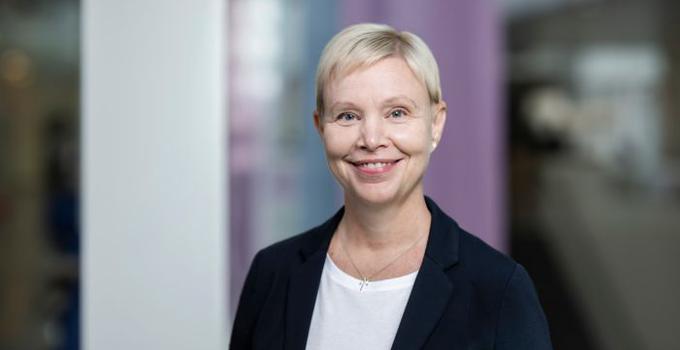
Photo: Linnea Bengtsson
She researches leadership that makes a difference in everyday working life
What makes managers effective, and what increases the risk of destructive leadership? These are some of the questions Susanne Tafvelin explores in her research. Since 1 March 2026, she has been a new professor at the Department of Leadership and Command & Control at the Swedish Defence University.
Leadership affects both our wellbeing at work and how well we are able to perform our duties. In her research, Susanne Tafvelin studies how constructive and destructive leadership behaviours affect employees’ motivation, health and performance.
But she is interested not only in what managers do. Just as important are the conditions in which they are expected to lead.
“We have seen, for example, that high demands and unclear roles increase the risk of destructive leadership behaviours. That is why we need to understand both the leadership itself and the context in which the manager operates”, says Susanne Tafvelin.
Leadership training should make a lasting difference
Another area of her research is leadership training. She examines how training programmes for managers can be designed to bring about genuine changes in day-to-day leadership.
“What is interesting is what happens when the manager returns to work. How can we design training initiatives so that they lead to new leadership behaviours rather than simply being something people do during the training itself?”
Susanne Tafvelin also leads a six-year research programme funded by Forte. The programme examines how robots and artificial intelligence in the public sector affect employees’ working environment and what managers need to consider when new technology is introduced.
Her interest in workplaces and organisations has been a constant throughout her professional life.
“We spend a large proportion of our waking hours at work, and our health is greatly affected by our working conditions. While studying psychology, I discovered just how enjoyable and interesting work and organisational psychology was. Since then, leadership and organisational issues have been a recurring theme throughout my professional life.”
A chance event led to a career in research
Becoming a researcher, however, was not something she had planned. After qualifying as a psychologist, she worked as an organisational psychologist in occupational health services and later at a consultancy in Umeå. When the company ran into difficulties, she was at risk of being made redundant.
At the same time, Umeå University advertised a doctoral position focusing on leadership in social services.
“It was really pure chance that I ended up pursuing a career in research. It was the only vacancy in my field where I was living at the time. I thought it sounded interesting, applied and got the job.”
At first, a career in research did not feel like an obvious fit.
“Initially, I found it difficult and somewhat of an uphill struggle. But once I found my feet, learnt the methods and how to write a scientific article, it became much more enjoyable. Today, I find it hard to imagine a more enjoyable job than being a researcher.”
More than 20 years of leadership research
Susanne Tafvelin joins the Swedish Defence University from Umeå University, where she has taught and conducted research at the Department of Psychology since 2004. During her time there, she has been a doctoral student, senior lecturer and associate professor.
She also established the CoLeadR research group, Community for Leadership Research. The group studies leadership and the working environment from several perspectives. Its research has included the working environment of young managers, the causes of destructive leadership, and how remote working affects managers and employees.
After more than 20 years at Umeå University, she wanted to try something new.
“The Swedish Defence University has long had a strong position in leadership research in Sweden. It therefore felt natural for me to come here. It feels like a real privilege to be part of an entire department of researchers specialising in leadership and organisations.”
The current security policy situation also makes her new role particularly relevant.
“Given the current international security situation, it feels particularly important to contribute useful knowledge that can benefit the Swedish Armed Forces.”
Wants to strengthen both research and the research environment
At the Swedish Defence University, Susanne Tafvelin wants to develop new research projects together with colleagues at the Department of Leadership and Command & Control. She also hopes to contribute her experience in areas such as research funding applications and academic publishing.
During the autumn, she will take part in two projects funded by the Swedish Armed Forces. One focuses on how the organisation handles situations in which managers are not functioning effectively in their role. The other examines the factors that influence employees’ willingness to remain in the Swedish Armed Forces.
“I hope to contribute both theoretically and methodologically. Above all, I look forward to working with my new colleagues to develop new knowledge that can be put to practical use.”
In brief
At the Swedish Defence University since: 1 March 2026.
Current: Newly appointed Professor of Leadership and Command & Control.
In my spare time: I spend time with my family.
Most recent book read: Syndafloder by Kristina Ohlsson.
Most recent film/TV series: Ted Lasso.
Hidden talent: I enjoy singing whenever the opportunity arises.
Happy to discuss: Foreign policy.
My driving force as a researcher: Curiosity and practical relevance.
More about
Page information
- Published:
- 2026-10-05
- Last updated:
- 2026-10-05