

Photo: Unsplash
Secrets can push military enthusiasts over the line
How can a strong interest in military secrets become a security threat, even when the people involved have no intention of harming Sweden? David Bergman, an affiliated researcher at the Swedish Defence University, has investigated this question. His research now forms the basis of a new book.
David Bergman’s research shows how secrets can confer status and shape groups in ways that lead people to cross boundaries. The research now forms the basis of the new book Nätverket – hur ett webbforum blev ett hot mot rikets säkerhet.
His starting point is people commonly described in Sweden as MÖP – individuals with an unusually strong interest in military affairs. Several court cases have shown how individuals have collected and handled sensitive military information on such a scale that they have become a security threat, despite apparently having no malicious intent.
“Even I thought that a link to espionage would eventually emerge. After all, that is the logical explanation for why someone would collect military information on a large scale. But my initial assumption turned out to be wrong. That left the big question – why?”
Secrets confer status
Part of the explanation lies in what David Bergman calls the secrecy paradox. Knowing something that others do not can confer status, but to gain that status, a person must also demonstrate that they possess exclusive knowledge.
“Knowing a secret can give you status within a group. But to gain that status, it is not enough simply to know the secret yourself. Other people also need to realise that you know something they do not.”
The research shows that secrets can therefore influence how groups form, how people communicate and which norms develop. In some contexts, the boundaries of what is regarded as acceptable can also shift.
Among other things, David Bergman has studied individuals prosecuted for offences against Sweden’s security after systematically mapping classified military infrastructure. The findings show how people who regard themselves as law-abiding can nevertheless cross ethical and legal boundaries.
“In some groups, individuals have crossed boundaries that they probably would not have crossed in other contexts.”
Broadening the understanding of security threats
As part of his research, David Bergman has analysed interviews conducted by the Swedish Security Service and data from the Flashback discussion forum to investigate how groups and networks form around classified information.
“The findings contribute to a broader understanding of what can constitute a security threat. Someone who causes harm does not necessarily have to be a spy working for a foreign power. Even people with no intention of causing harm can create security risks through their actions”, says David Bergman.
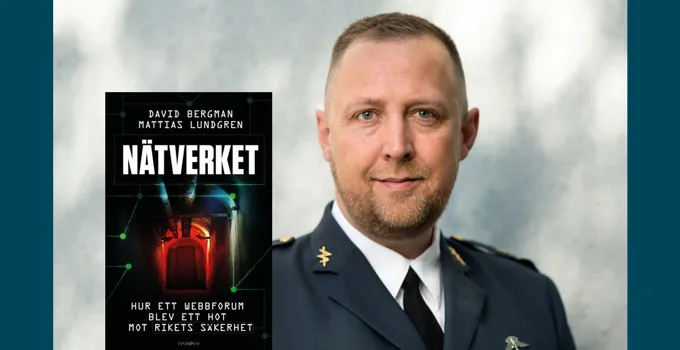
David Bergman är affilierad forskare vid Institutionen för ledarskap och ledning vid Försvarshögskolan.
Research becomes a book
The research now forms the basis of the book Nätverket – hur ett webbforum blev ett hot mot rikets säkerhet, written by David Bergman together with Mattias Lundgren. Lundgren is also a military officer and, as part of his dissertation work on the Joint Advanced Command and Staff Programme, studied the forums and subcultures behind the events. The book portrays a network of people with an unusually strong interest in military affairs who spent several years mapping Swedish military infrastructure through a closed online forum.
More about the book
The book Nätverket – Hur ett webbforum blev ett hot mot rikets säkerhet, will be published by Lind & Co on 29 October 2026.
More about
Page information
- Published:
- 2026-10-08
- Last updated:
- 2026-10-08