
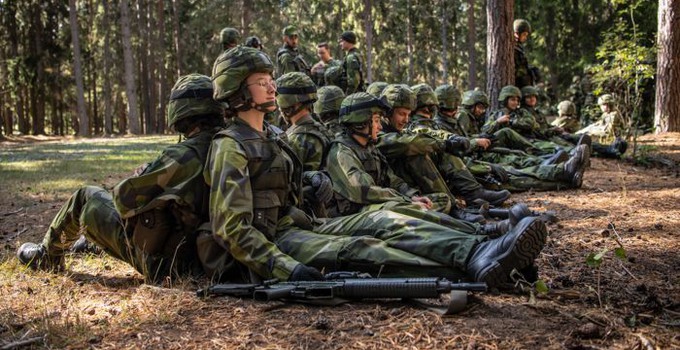
Daniel Smith hopes that his research on what builds cohesion in military units will be able to be used to understand the will to defend and to develop military education and promotion pathways. Photo: Bezav Mahmod/Swedish Armed Forces
Why soldiers stick together in battle
How do soldiers manage to cooperate and make decisions in the chaos of the battlefield? A new doctoral thesis from the Swedish Defence University takes the soldiers’ own stories as its starting point and challenges previous research on combat cohesion.
In war it is decisive that military units can act in coordination, but what is it really that makes this possible? In his thesis, Daniel Smith examines the dynamics of combat from the inside, based on ethnographic field studies at the frontline in Ukraine during the counter-offensive of 2023.
"I was interested in what we can learn from an ongoing, high-intensity war in Europe. My research project was not crystallised when I began to collect data, but during the course of the work it became clear that previous research on combat cohesion and the empirical reality I saw in Ukraine did not match one another. Then of course it became interesting to study precisely that", says Daniel Smith, captain and doctoral student in war studies at the Swedish Defence University.
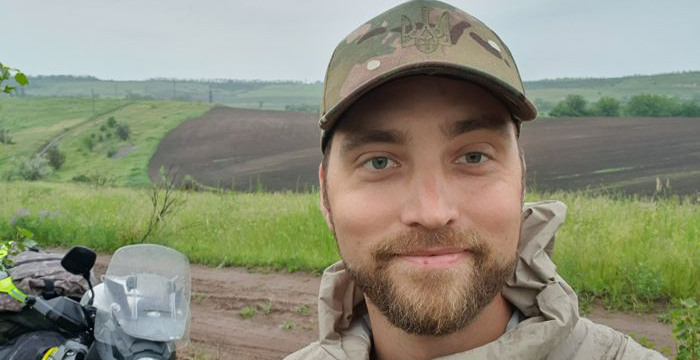
Daniel Smith got around on a motorbike in Ukraine when he carried out the field studies on which the thesis is based. “Being able to be on site has been a key in this work and I could not have managed to get these interviews in any other way,” he says. Photo: Private
Unlike previous studies which have often focused on structures and leadership, this research takes its point of departure in the combatants’ own stories. The result shows that combat cohesion, is a temporary phenomenon which is built on three central prerequisites: self-image, leadership and shared understanding of combat.
Fighting to preserve oneself
One of the thesis’s most important conclusions is that soldiers are not primarily motivated by patriotism or loyalty to the group, but by the will to preserve their self-image – the personal narrative of who one is and wants to continue to be.
"For many Ukrainian soldiers it is about protecting their relationships, their dreams of the future and their place in the world. Here, for example, the mobile phone becomes a lifeline to civilian life and a reminder of why one fights", says Daniel Smith.
To in military education attempt to tear down the civilian identity in order to build up a “soldier identity” is therefore counterproductive, he believes.
"The motivation is already there, rooted in the personal history. War threatens in a fundamental way what possible futures may exist, and even if a person has not thought about it before, a combatant role can become the only reasonable way forward in order to be able to continue to be oneself", he says.
Leadership is a matter of perceived legitimacy
Trust in leadership is decisive for cohesion, but not in the form of formal merits or rank. It is about how the soldiers perceive their commanders in the moment.
"A commander can be seen as tough but fair by some, and as weak or arrogant by others. It is the soldier’s own story about the leader that determines whether orders are followed or not", says Daniel Smith.
A common language for combat
The third component concerns training, but not to be able to march in perfect formations. Instead what is advocated is a broad repertoire of realistic scenarios where the soldiers learn to interpret the logic of combat, make decisions and act independently in uncertain situations.
"The more possible situations one has trained for, the less chaotic real combat is experienced. It creates security, capacity for improvisation and resistance to stress", says Daniel Smith.
For the armed forces of the future
He hopes that the research will be used to understand the will to defend and to develop military education and promotion pathways.
"The thesis breaks with previous research and common perceptions of how one ought to proceed in order to create powerful and competent units. Anyone who is interested in the Russian war of invasion in Ukraine, modern warfare, or is generally interested in military matters definitely has much to gain from this thesis", he says.
Publication:
Daniel Smith (2025): Focalizing Warfighters: Combat Cohesion from Below
Daniel Smith defended his PhD in War Studies at the Swedish Defence University on 26 September 2025.
More about Daniel Smith's research: Field studies in Ukraine provide insights about cohesion in military units
Page information
- Published:
- 2025-09-26
- Last updated:
- 2025-09-29