
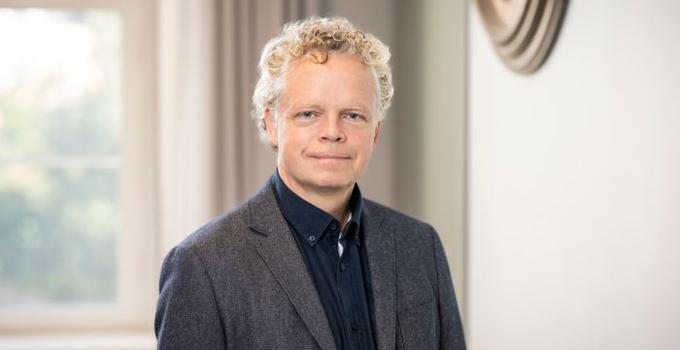
Photo: Linnea Bengtsson
Understanding war to make a difference
Erik Melander has spent more than 30 years researching war and armed conflict, from Bosnia and Nagorno-Karabakh to South Africa, Thailand and Ukraine. As a newly appointed professor at the Swedish Defence University, he combines deep academic expertise with a strong commitment to Sweden’s total defence and to international support for Ukraine.
Since the summer of 2025, Erik Melander has been working as Professor of War Studies at the Swedish Defence University, conducting research closely linked to the war in Ukraine. One ongoing project focuses on Ukrainian war veterans and active soldiers and their views on gender equality and democracy. In early 2026, he will launch a new project examining how Ukraine’s emergency services cope with extreme psychological pressure and how this affects staffing. He is also planning studies of land warfare in Ukraine.
“I want to understand how individuals think and act in conflict situations, which can contribute both to Sweden’s total defence and to international support for Ukraine”, he says.
Research that makes a difference for Ukraine
After Russia’s full-scale invasion of Ukraine in 2022, Erik Melander began reflecting on how he, as a researcher, could contribute in a more practical way.
“The security situation had been deteriorating for a long time; that was one of the reasons I joined the Home Guard in 2018. I felt a need to do something concrete, and then there is no better place to be than the Swedish Defence University.”
Here, he teaches future officers and links his research to total defence and international support for Ukraine.
“It is something quite special to teach those who will become our future officers. And everyone here is interested in security and defence issues.”
Insights from Moscow during the Cold War
Erik Melander’s interest in war and conflict began early. After completing his national service at the the Military Interpreter School in Uppsala, he worked at the Swedish Embassy in Moscow from 1989 to 1990. The impressions he gained in Moscow at the end of the Cold War sparked his curiosity about how conflicts escalate and how they affect societies.
“I also worked for a short period at the embassy in Tallinn and witnessed first-hand the Soviet threat and oppression that Russia continues to perpetuate today.”
He began his doctoral studies in Peace and Conflict Research at Uppsala University in 1993 and served abroad as an interpreter with the Swedish battalion in Bosnia in 1996.
“My doctoral thesis focused on escalation dynamics in the Bosnian war, where I combined field studies with the collection of extensive data. Thanks to my time as an interpreter, I was able to conduct interviews on site in the local language.”
Since then, he has carried out research on conflicts in various parts of the world and conducted fieldwork in, among other places, Azerbaijan, Armenia, South Africa and Thailand.
Combining different methods
“I have often combined case studies, field trips and interviews with collecting large datasets, enabling the analysis of information using statistical methods.”
Erik Melander most recently held a professorship at the Department of Peace and Conflict Research at Uppsala University, where he also served as Director of the university’s conflict database, a research programme that collects, analyses and publishes data on armed conflicts worldwide.
“It is tremendously exciting to discover new things. Sometimes I feel like an explorer venturing into the blank spaces on the map. I may have a huge amount of data loaded into my statistical software, and when I press the keys, I see results no one has ever seen before.”
He has also served as Director of the Alva Myrdal Centre for Nuclear Disarmament, as a lecturer in the Rotary Peace and Conflict Studies Programme at Chulalongkorn University in Thailand, and as Adjunct Research Professor at the Joan B. Kroc Institute for International Peace Studies at the University of Notre Dame in the United States. At the Swedish Defence University, he hopes to contribute both his broad knowledge of the research field and his methodological expertise in working with large databases to help build new research environments.
Understanding war as an extreme phenomenon
He emphasises that his research is about understanding the extreme phenomena of war, but also about generating knowledge that can be of practical use. In the long term, he hopes to build lasting partnerships with colleagues in Ukraine and contribute experience that is relevant both now and in the future.
“The lessons we can draw from Ukraine will remain relevant for a very long time. Even if some form of ceasefire were to be reached, there would still be much to learn and much to do, both for them and for us.”
In brief
At the Swedish Defence University since: 1 July 2025
Current project: A new research project examining how the Ukrainian emergency services manage extreme psychological pressure and the consequences this has for staffing.
When I’m off work: Training, outdoor activities, reading books and spending time with friends.
Last book read: Dying Every Day: Seneca at the Court of Nero by James Romm.
Happy to discuss: Life’s big questions, such as the meaning of life, what drives people and what makes societies function.
My motivation as a researcher: The joy of discovery and contributing knowledge.
Page information
- Published:
- 2025-12-01
- Last updated:
- 2025-12-04