
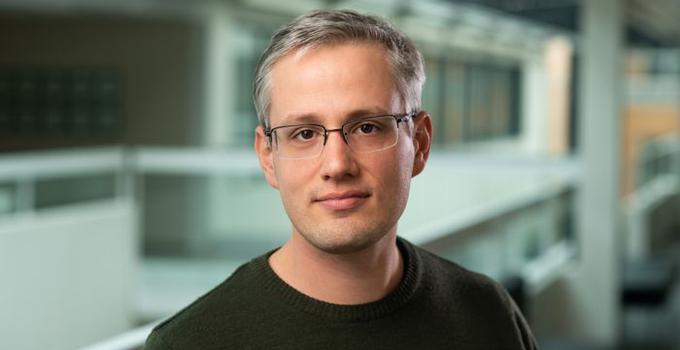
Photo: Anders G Warne
"A privilege to work deeply on a topic I really care about"
After serving in the Brazilian Armed Forces and humanitarian operations in conflict zones, Henrique Garbino turned to research. On 4 September 2026, he will defend his doctoral thesis, examining why some armed groups choose to use landmines while others show restraint.
Henrique Garbino came to academia after a career that took him from the Brazilian Armed Forces to humanitarian operations in conflict zones around the world. Before beginning his PhD at the Swedish Defence University in 2021, he worked with explosive ordnance disposal, mine action and civil-military coordination in countries such as Ukraine, Colombia, Haiti, and Tajikistan. His experiences in the field sparked an interest in understanding armed conflict not only in practice, but also through research.
How armed groups make decisions about violence and restraint
His PhD project began with a question that challenged common assumptions about armed conflict.
“I had thought of landmines as weapons used quite indiscriminately, especially by rebel groups in civil wars. Then I discovered that more than 50 non-state armed groups had voluntarily accepted a ban on anti-personnel mines. That made me wonder why some groups choose restraint while others do not”, says Henrique Garbino.
His thesis examines how armed groups make decisions about violence and restraint. Drawing on case studies from the Philippines and Colombia, Garbino shows that restraint is shaped by a combination of factors, including civilian support, legitimacy concerns, organisational identity, tactical considerations and practical constraints.
“Some groups avoid landmines because they want legitimacy. Others because the weapons are not tactically useful, because they see them as the wrong kind of weapon, or because they lack the capacity to use them effectively,” he says.
One of the central findings is that restraint and violence can coexist.
“Restraint does not necessarily mean less violence. Sometimes it simply shapes how violence is exercised”, says Garbino.
A rewarding doctoral journey
Looking back on his years as a doctoral student, Garbino describes the experience as both intellectually challenging and highly rewarding.
“Doing a PhD can be demanding and uncertain, but I have mostly experienced it as a privilege to have the time, freedom and support to work deeply on a topic I really care about”, he says.
He highlights the support from supervisors, colleagues and the academic environment at the Department of War Studies as important factors throughout the project.
“My supervisors encouraged me to stay grounded in real-world problems while also becoming more rigorous, systematic and theoretically clear. I learned a great deal from seminars, research groups and discussions with colleagues.”
Combining research and teaching with practical experience
The opportunity to combine academic work with practical experience was another important aspect of his doctoral studies.
“The Swedish Defence University gave me the flexibility during my PhD studies to undertake deployments to Ukraine (2022), Nagorno-Karabakh (2024), and Gaza (2024).”, he says.
Looking ahead
After the defence, Garbino hopes to continue working at the intersection of research and practice.
“I hope to keep one foot in academia and one foot in the humanitarian sector,” he says.
He plans to continue teaching and to expand his research into new areas, including the use of explosive devices by criminal groups and the broader political and social effects of demining.
“One area I would like to explore is the use of explosive devices by criminal groups, including in places like Sweden. Another is understanding what demining does for communities, governance and post-conflict recovery, beyond simply clearing contaminated land.”
At the same time, he hopes to continue taking part in humanitarian deployments focused on explosive ordnance disposal and civil-military coordination.
“That connection to practice is really important. It keeps my research grounded in real problems, and it gives me the opportunity to apply some of what I learn through research”, says Henrique Garbino.
Publication
Henrique Garbino (2026): Unearthing Restraint: The Use and Non-Use of Landmines by Armed Groups
Page information
- Published:
- 2026-08-24
- Last updated:
- 2026-08-25