
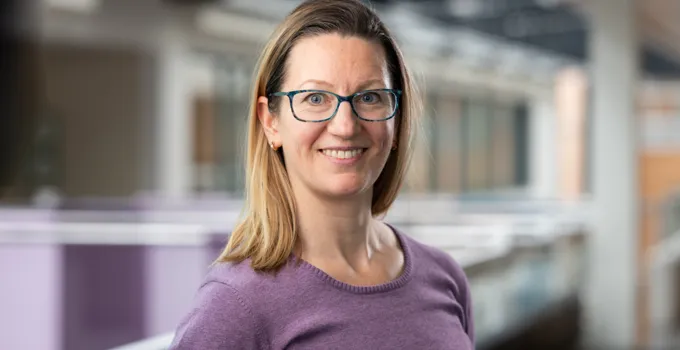
Photo: Anders G Warne
How can civilians be better protected in war?
How do multinational military operations affect civilian safety? And what happens to military decision-making as artificial intelligence plays an increasingly important role? These are some of the questions driving the research of Linnéa Gelot, Professor of War Studies at the Swedish Defence University since 1 October 2026.
Linnéa Gelot’s research focuses on the use of military force in armed conflict and on how people living in war zones seek to protect themselves and others. She examines both the actions of military organisations and how civilians assess risks, organise protection and respond to threats.
“I am interested in how the use of military force and civilians’ own security strategies influence each other. I want to understand how people deal with threats during armed conflict and how their knowledge and actions are taken into account – or overlooked – in military operations”, she says.
Civilians take an active role in their own protection
A central focus of her research is how military organisations can prevent and mitigate civilian harm in the planning and conduct of military operations. Linnéa Gelot emphasises that civilians are not passive recipients of protection. They develop their own survival strategies, assess risks and enhance security during armed conflicts.
“Civilians are not simply recipients of protection. They actively assess risks and respond to threats. Understanding this is essential to assessing the consequences of multinational military operations and preventing civilian harm”, she says.
Another strand of her research examines how responsibility for civilian protection is shared when military forces plan and conduct operations together.
“In joint operations, efforts to prevent and mitigate civilian harm must extend to all participants, so that risks are not merely shifted from one actor to another and responsibility remains clear.”
Exploring how AI affects military decision-making
Linnéa Gelot also studies how artificial intelligence is changing military planning and decision-making. As AI-based systems are increasingly used to analyse information and support military decisions, questions arise about how assessments are made and who bears responsibility for the consequences.
“I examine what knowledge informs decisions, how military assessments are shaped and how responsibility is allocated when AI-based decision support is used in planning.”
She emphasises the importance of understanding how increasing automation affects the ability to scrutinise and evaluate military decisions.
“As AI-based decision support becomes more widely used in military operations, we need to understand how it affects planning and our ability to assess the grounds on which decisions are made and the consequences they may have.”
Curiosity led her into research
Linnéa Gelot’s path into academia began in the Welsh university town of Aberystwyth. She completed her master’s degree there and gained insight into academic research through contact with doctoral students.
“I spent time with both master’s and doctoral students, which gave me a better understanding of what pursuing a PhD in the UK could offer and what it would require.”
After working as a postdoctoral researcher and lecturer at the School of Global Studies at the University of Gothenburg, she went on to become a senior researcher at the Nordic Africa Institute and later at the Folke Bernadotte Academy.
She joined the Swedish Defence University in January 2022 and became Professor of War Studies on 1 October 2026.
Aiming to strengthen civilian protection
In the longer term, Linnéa Gelot hopes her research will contribute to a greater role for civilian perspectives in the planning and conduct of multinational military operations.
“I hope to contribute to a more precise understanding of how wars are fought and how people act to survive them. My ambition is for knowledge of civilian safety and the strategies people use to protect themselves to play a more prominent role in the analysis of military operations.”
Her research also aims to inform efforts to prevent and mitigate civilian harm and to clarify responsibility when military forces operate together. Curiosity and a desire to challenge established assumptions motivate her research.
“I want to question established assumptions about who creates security in wartime and what shapes the options available to people,” she says.
In brief
Current role: Professor of War Studies at the Swedish Defence University since 1 October 2026.
At the Swedish Defence University since: January 2022.
In my spare time: Dancing, swimming and spending time with family and friends.
Most recently read book: These days, I mostly read to and with my seven-year-old.
Most recently watched TV series: Slow Horses and HPI.
Hidden talent: Perseverance in pursuing my goals.
Happy to discuss: Life’s big questions and psychology, but also just about anything else. I enjoy exploring ideas and considering different perspectives, especially when the conversation involves humour and unexpected angles.
What motivates me as a researcher: Curiosity and a desire to explore creative avenues of research.
Page information
- Published:
- 2026-10-27
- Last updated:
- 2026-10-27