
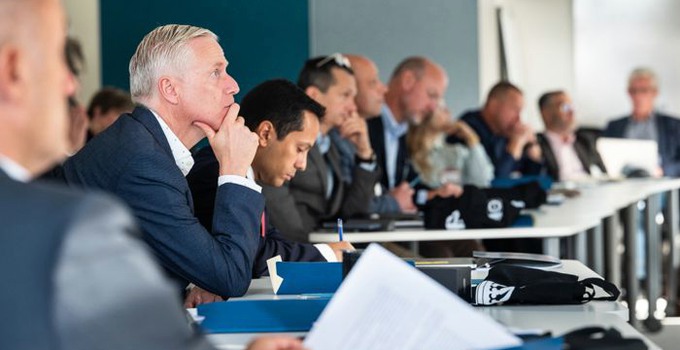
The event brought together representatives from Ukraine, Sweden, Finland, Norway, the Netherlands, the United Kingdom, the United States, Lithuania, Greece, Italy and Portugal. Photo: Anders G Warne
Focus on logistics in air operations at NATO workshop
On 24–25 September, the Swedish Defence University hosted its first NATO Science for Peace and Security (SPS) Advanced Research Workshop as a host nation.
The theme of the workshop was “Logistics in Support of the Aerial Domain Operations and Missions”, bringing together participants from across Europe and North America.
“Logistics may not be the most glamorous part of military power, but it often makes the difference between success and failure. This is an area where international knowledge exchange is absolutely crucial”, says Viktoriya Fedorchak, Associate Professor in War Studies at the Swedish Defence University and one of the workshop’s organisers.
The workshop gathered both military practitioners and civilian academics to explore how logistical solutions shape air operations in today’s security environment. Discussions focused on two main aspects: national approaches and best practices in providing logistics for air operations, and the current logistics solutions in employing new technologies in warfighting.
“The devil is in the details. Even something as basic as a shortage of trucks can undermine flexibility and limit the impact of air power. Sharing experiences across countries strengthens our collective capability”, says Fedorchak.
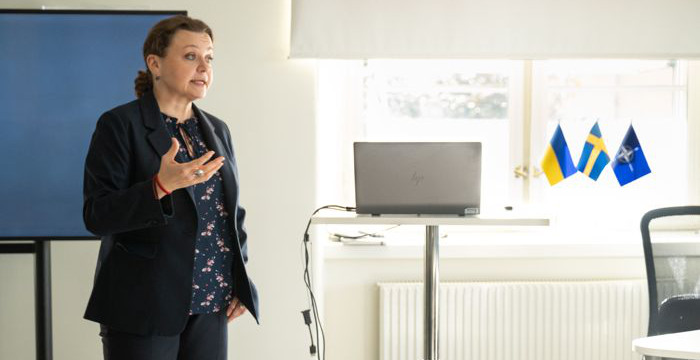
Viktoriya Fedorchak, Associate Professor in War Studies at the Swedish Defence University. Photo: Anders G Warne
Cooperation between Ukraine and Sweden
The workshop is the result of a joint grant application to the NATO SPS programme by Viktoriya Fedorchak and Col\Dr Roman Nevzorov, the Head of Department of Tactical Aviation, Ivan Kozhedub Kharkiv National Air Force University, Ukraine.
“Although due to the ongoing war, the Kharkiv University had to disperse across the territory of Ukraine, it continues to teach Ukrainian pilots, engineers, and air force practitioners in accordance with the modern standards of professional military education and NATO requirements”, says Fedorchak.
The Ivan Kozhedub Kharkiv National Air Force University also conducts an international collaboration program, of which the Swedish Defence University is an active participant
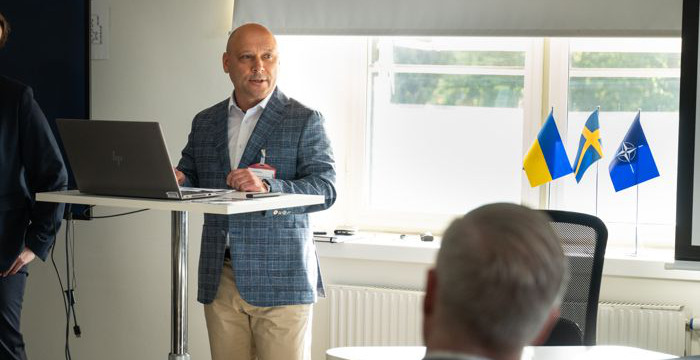
Colonel/Dr Roman Nevzorov, Head of Department of Tactical Aviation, Ivan Kozhedub Kharkiv National Air Force University, Ukraine. Photo: Anders G Warne
Insights from the workshop
Some of the key takeaways from the workshop include:
- Agile combat employment requires flexibility not only in personnel readiness, but also in rapid adjustments of logistics supply to the changes in the operating environment.
- Passive air defences, i.e. measures that reduce the effect of an air attack without directly combating the attacker, have become as sound today as they were during the Cold War.
- A one-sided approach to air power is no longer enough to project power and provide support in modern operations; a systematic, multi-faceted total defence approach with inclusion of civil society, military, and civilian industry together with various branches of the military is required in order to employ air power to its fullest capacity over a prolonged time.
“The insights from the workshop are to be used in our ongoing teaching and research initiatives at the Swedish Defence University in general and the Air Operations Division, specifically. The acquired knowledge will be of utmost relevance for our Joint Advanced Command and Staff Programme”, says Fedorchak.
Page information
- Published:
- 2025-09-29
- Last updated:
- 2025-09-30