
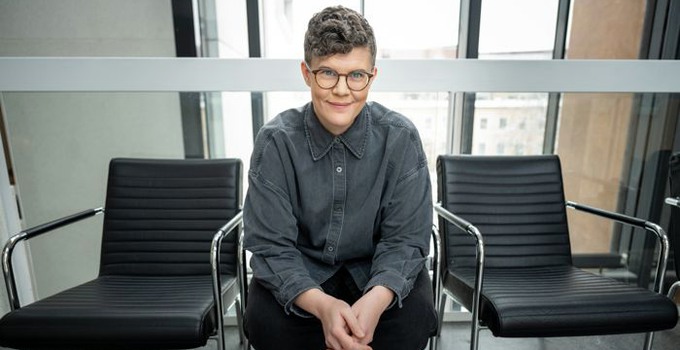
Anna Danielsson has the city in focus
Meet your professor and her research
Anna Danielsson is a senior lecturer in War Studies on the Master's programme War and Defence. You will meet her in the elective course When War Meets the City: Urban Wars and Urban Warfare during either semester 2 or 4.
Anna will open your eyes to what both scholars and practitioners now agree on: that military operations in cities constitute one of the most significant strategic security issues of the twenty-first century.
Tell us about your academic background before joining the Swedish Defence University.
"I earned my PhD in Political Science at Uppsala University, with a thesis on economic informality and state-building in war-affected countries. After that, I held a postdoctoral position at the University of Tübingen in Germany, and later spent two years as a visiting researcher at one of Britain’s leading centres for war and peace research in Aberystwyth, Wales. During that time, I heard that the Swedish Defence University was advertising a position as Assistant Lecturer in War Studies. I started in January 2019 and was promoted to Associate Professor and Senior Lecturer in War Studies two years later."
What attracted you to the position?
"What drew me here was the field of War Studies – for two main reasons. Firstly, because it invites the study of war, warfare, and peace in ways that sometimes overlap with, but often differ from, the approaches of other disciplines. This creates fertile ground for stimulating discussions with both the international and national research communities."
“I was also drawn to the idea of a meeting place between academia and the military profession, particularly since my research often explores practice, practical knowledge, and action in various contexts."
You research ‘urban wars, urban security, urbicide, joint operations, and the production of knowledge in international interventions.’ Can you describe your research field?
"I usually say that I have two main research agendas, and they are united by a focus on the city – on the urban."
"The first concerns urban wars and urban warfare. Within that, I am engaged in two projects: one examines American military thinking about combat and operations in urban environments from the mid-nineteenth century to the present day. The other focuses on the concept and phenomenon of urbicide – the killing of a city, or the destruction of the urban, in war and conflict."
“My second research agenda concerns the production of knowledge and expertise within international interventions. I currently hold a three-year research grant from Formas to study how knowledge and place are produced within the context of international peacebuilding in urban environments."
What fascinates you about focusing on the city and the urban?
“I’ve always had a personal attraction to cities – to urban life and the dynamism and ‘pulse’ that often, and in various and sometimes contrasting ways, characterise them.
“I’m also fascinated by questions of knowledge and knowledge production, not least given the rise of what is often called the ‘knowledge society’. This development has meant that the production of knowledge can no longer be understood as solely a matter for universities, but rather as something that permeates and influences global governance in a broad sense.
“My two foci and research agendas meet here, since the military need for knowledge about the city is often highlighted as one of the major challenges in relation to urban wars and urban warfare.”
How has societal and political interest in your field evolved, and how would you describe its current status?
“The idea that escalating urbanisation and warfare in cities represent one of the key security challenges of the twenty-first century has become something of a truism in today’s security discourse and within War Studies. A frequently repeated mantra among both scholars and practitioners is that military operations in cities are among the most important strategic security issues of our time. Western military strategists increasingly regard combat and operations in urban environments as inevitable.
“On a broader societal and political level, I’ve seen a rapid increase in interest in cities in war, peace, and peacebuilding over the past decades. Russia’s war of aggression against Ukraine has placed Ukrainian cities such as Mariupol and Bakhmut in the spotlight. Similarly, public and political interest in questions of knowledge and expertise has grown steadily, not least in light of recent debates around ‘fake news’ and similar phenomena that challenge our understanding of knowledge itself.
“Interest in the urban more generally has long been profound and widespread, with extensive research in fields such as sociology, urban studies, and political science – and, to some extent, within War Studies.”
Why is your field of research so important?
“The issue of urban wars and urban warfare is crucial partly because of global urbanisation, and partly because many military strategists – especially in the US and the UK – regard the urban as the battlefield of the future. This assumption alone, whether correct or not, makes the subject worth investigating.
“Furthermore, we cannot understand why international interventions look, progress, and produce effects as they do without understanding the conditions under which knowledge and expertise are produced, disseminated, taken for granted, become controversial, or are challenged by other forms of knowing.”
Tell us about your latest research project "Urban wars and postconflict reconstruction: Peacebuilder production of knowledge and space in urban environments".
“The project explores how knowledge and urban spaces are produced within international peacebuilding efforts in cities affected by war and military violence. It addresses a knowledge gap in existing research. On one hand, cities and urban environments are now seen as central to both military organisations and various civilian actors engaged in peacebuilding. On the other, these spaces are often taken for granted – treated as static backdrops against which interventions unfold, rather than as phenomena that shape the interventions themselves and the knowledge and expertise they rely on.
“This is problematic in light of the core sociological insight that places and cities are not given, but produced through knowledge-generating practices.
“Thus, there is a gap in how existing research has failed to analyse the knowledge production that shapes international interventions in urban contexts. To address this, the project examines UN-led urban reconstruction projects in post-conflict Kosovo.
“Although the project arises from a research gap, its themes are highly relevant globally and directly connected to the UN’s Sustainable Development Goals, particularly that of sustainable cities. It also links closely to broader global debates – both within military organisations about urban wars and their effects, and within discussions on post-conflict urban development and city planning.”
How can this research project be applied and benefit society?
“I have published articles in international academic journals that challenge prevailing understandings of how knowledge and expertise are produced within urban peacebuilding, showing how urban areas in Kosovo are conceptualised and constituted in very limited ways within contemporary peacebuilding discourse. This is particularly striking given the legacy of the war in the late 1990s, which often disappears entirely from current discussions.
“The aim is for the project’s findings to reach both residents and policymakers in Kosovo, ideally contributing to more diverse approaches to urban reconstruction projects.”
You’ve developed concepts used within your field. Tell us more!
“My work is often theoretically driven, and in both current and previous projects I have developed concepts and theories that have gained international traction in academic debates. For instance, the concept of the object of intervention, which rethinks how we can understand and theorise international interventions. I have also contributed to theoretical developments in the literature on knowledge production and expertise in relation to war and peace.”
Do you already have ideas for your next research step?
“Yes, I’d like to develop a project on urban warfare that focuses on practical knowledge and the ability to understand and assess the urban environment, which many argue is a highly distinctive operational setting. I’d also like to expand and deepen my current project on American military thinking about combat and operations in urban environments from the mid-nineteenth century to today.”
How do you balance teaching and research?
“It’s actually quite an easy balance, because I genuinely enjoy both teaching and research. There are often cross-fertilisations between the two, both theoretically and empirically. For instance, my colleague Kristin Ljungkvist (Senior Lecturer in War Studies at the Swedish Defence University) and I have just developed and taught a new course on urban wars and urban warfare in the master’s programme War and Defence, which was very well received by students and closely linked to our respective research agendas.”
Is there a particular approach that you want your students to take with them?
“A key idea I often return to in my teaching is the difference between having an opinion and formulating an argument. This becomes particularly important in supervision. It’s easy to have an opinion about a topic – your own or someone else’s – but much harder to develop a solid argument or sustain a thesis.”
What aspect of teaching do you enjoy most?
“I enjoy various forms of teaching, but particularly supervision and seminar discussions, as they allow for deeper exchanges with students and their ideas.”
How would you describe your teaching style?
“I think I’m perceived as fairly relaxed and personal in my teaching style, but also as someone who sets clear expectations for my students.”
What advice would you give to a student wanting to pursue a similar career?
“Read broadly and cultivate a wide range of interests, but also try to find that one topic or phenomenon that truly excites you – something you want to spend years learning more about and understanding in depth.”
Meet Anna Danielsson here:
Master's Programme in War and Defence: Anna teaches the course "When war meets the city: Urban wars and urban warfare".
Title: Associate Professor and Senior Lecturer in War Studies
At FHS: Since January 2019
Driving force as a researcher: Curiosity and a willingness to learn
Last book read: "Objectivity" by Lorraine Daston and Peter Galison
Music: It varies, but lately I've listened a lot to Boygenius and Esbjörn Svensson Trio
Hidden talent: Perhaps that I know quite a lot about the history of Stockholm, as I worked as a guide in the city many years ago.
Page information
- Published:
- 2025-10-24
- Last updated:
- 2026-06-11